Survey methodology
The Survey Lifecycle: From Plan to Action
A structured, repeatable process for running surveys that deliver insight you can act on.
Every survey and consultation SurveyOptic supports follows the same nine-stage survey life cycle. Each stage has a clear purpose, and skipping one is the most common reason a survey produces data that nobody uses. This page sets out what happens at each stage, why it matters, and what good practice looks like.
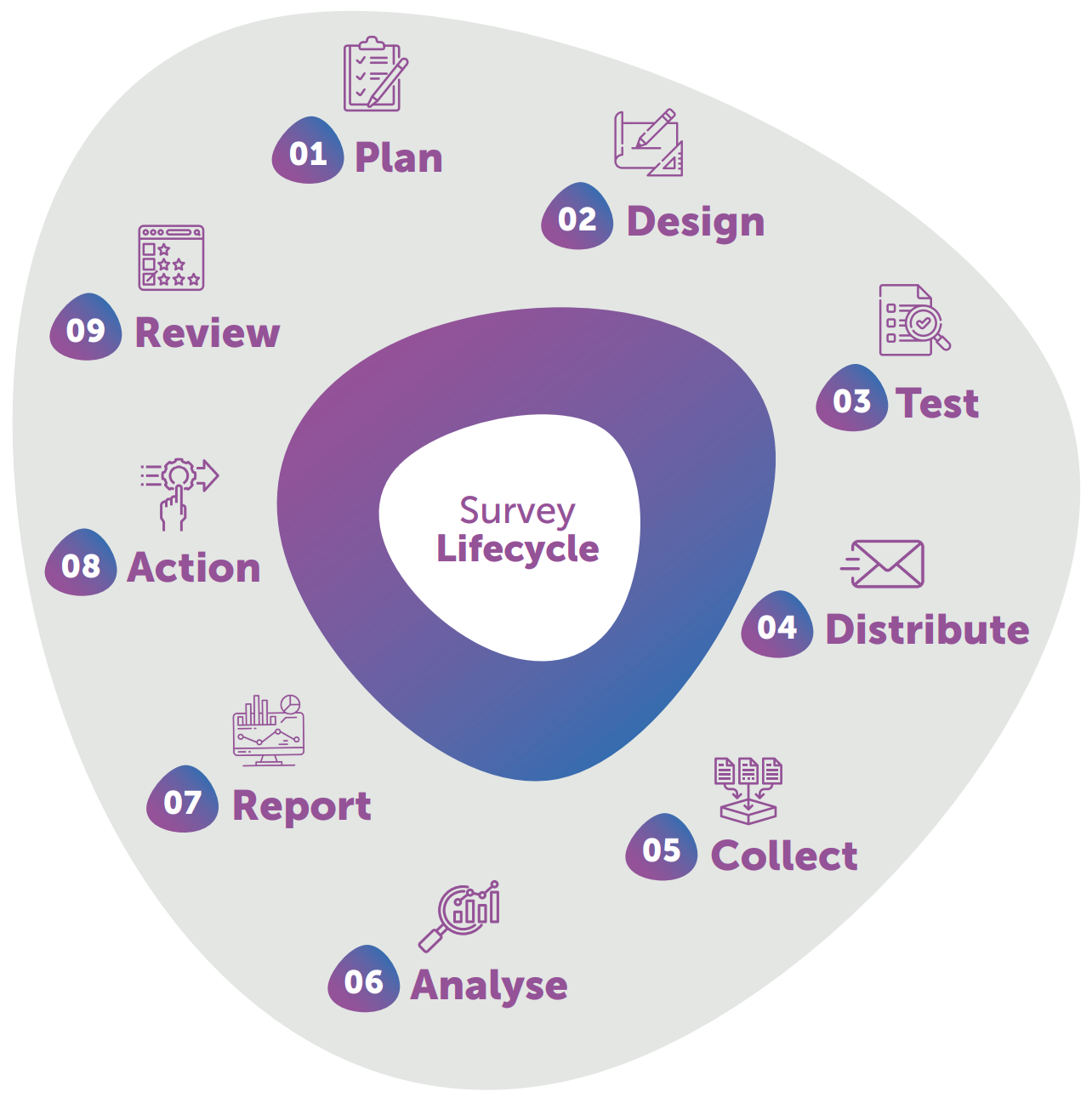

Stage 1 of 9
Plan
Agree what you need to know, who you need to hear from, and what you will do with the answers.
Every successful survey starts with clarity about what you need to know and who you need to hear from. This stage sets the objectives, defines the audience — whether a full census, a stratified sample, or a targeted population — and maps the stakeholders who will use the results.
You also build a realistic timeline, allocate resources, and agree how the findings will feed into decisions. Get this right and you avoid the most common failure: collecting data that no one has committed to act upon.

Stage 2 of 9
Design
Turn objectives into questions people can answer honestly and accurately.
Good design turns your objectives into questions that people can answer honestly and accurately. You select the topics and factors you want to measure, write the questions, and craft the invitation and reminder messaging. Then you set the logic that guides each respondent through the right path.
Accessibility, language and cognitive load matter here: the survey needs to work for everyone in your audience, including people using screen readers or answering in Welsh, Arabic or any of the 67 languages SurveyOptic supports.
For employee engagement surveys, this is where a validated factor model such as MAPPED is mapped to the question set, so you measure what you claim to measure.

Stage 3 of 9
Test
Prove the survey works before your audience sees it.
Testing is not a quick glance at a preview link. It means checking the flow, validating the logic, and confirming that every question collects data in the format you expect.
Stakeholders should review and sign off the survey formally. A live pilot with a small representative group will surface problems that internal review misses: ambiguous wording, broken routing, or questions that feel invasive.
Record what you change and why: version control matters when a board or regulator later asks how the survey was assured. Our guide to testing your survey walks through the checks step by step.

Stage 4 of 9
Distribute
Reach your audience through the channels they actually use.
Distribution is the bridge between preparation and response. Start with pre-survey communications that explain why the survey matters and what will happen with the results, because trust drives response rates.
Then send invitations through the channels your audience actually uses: email, SMS, QR codes for deskless workers, or secure personal links for closed populations. Automated reminder chains nudge non-respondents without harassing them, while suppression lists and one-click unsubscribe keep you compliant and respectful.

Stage 5 of 9
Collect
Monitor progress while protecting data quality and respondent trust.
Once the survey is live, your job is to monitor progress while protecting data quality and respondent trust. Watch response rates in real time, spot units or cohorts that are falling behind, and intervene where appropriate — but never in ways that compromise anonymity or confidentiality.
Strong collection practice also means accessibility controls, save-and-return for long surveys, and clear retention rules so personal data is not held longer than necessary. Every decision here affects whether your final dataset is representative, and whether respondents will take part again next time.

Stage 6 of 9
Analyse
Turn raw responses into evidence you can trust.
Analysis turns raw responses into evidence. Begin with data cleaning and quality assurance: remove duplicates, check for straight-lining or contradictory answers, and confirm that your responses reflect the population you intended to reach.
Then apply the right statistical tools — segmentation, significance testing, key-driver analysis or respondent clustering — to surface patterns that are genuine rather than noise. For open-text responses, text analytics can extract sentiment and topics at scale, but review by people who understand the context is what turns keywords into insight.

Stage 7 of 9
Report
Tell decision-makers what the evidence means and what to do about it.
A report is not a data dump; it is a narrative that tells decision-makers what the evidence means and what they should do about it. Structure findings around the objectives set at the planning stage, highlight strengths as well as gaps, and define benchmarks clearly so progress can be tracked over time.
Distribution matters too: different leaders need different levels of detail, and reporting thresholds must stop small groups being identified. The best reports arrive in time to inform the decisions they were commissioned for.

Stage 8 of 9
Action
Turn findings into owned, measurable commitments.
Insight without action is organisational waste. This stage turns findings into specific, owned commitments with deadlines and measurable goals — not vague promises to “look into it”.
Good action planning links each action back to the factors that drove your key findings, and carries unfinished work into the next survey cycle. Completion is tracked visibly, so accountability is real.
Where the organisation needs help building momentum, facilitated workshops and leadership coaching can bridge the gap between report and change.

Stage 9 of 9
Review
Close the loop and make the next cycle sharper.
The final stage closes the loop. Assess whether the actions taken have moved the measures they were meant to move. Wave-on-wave comparison and significance testing separate real change from statistical noise.
Capture what worked, what did not, and what the next cycle should do differently — then record the learning so it survives team changes. A survey programme that reviews honestly gets sharper with every wave.
Platform, service, or both
You can run the whole lifecycle yourself on the SurveyOptic platform, hand it to our team, or mix the two stage by stage.
Self-service on the platform
Your team designs, distributes, analyses and reports in SurveyOptic, with templates, automation and dashboards built for each stage. See the platform features.
Fully managed by our team
Experienced survey practitioners run the stages you choose, from planning and questionnaire design to analysis, reporting and action-planning workshops. See our survey services.
The lifecycle in your sector
The nine stages stay the same. What changes is the audience, the obligations and what counts as evidence.
Employee engagement and staff surveys
Annual census surveys, engagement measured against the MAPPED factor model, and manager-level action plans.
Employee engagement surveysHealthcare and patient experience
Patient-reported outcomes, patient experience and staff surveys for NHS and independent providers.
Surveys for healthcarePublic consultation and government
Consultations and citizen surveys for departments, regulators and arm's-length bodies, joined up to GOV.UK platforms.
Surveys for governmentPulse programmes
Short, frequent surveys between annual waves that track whether actions are working.
Pulse surveys
A documented, assured process
The lifecycle is how we deliver every project, not a diagram for the brochure. Survey delivery runs inside our certified management system, so plans, changes and sign-offs follow an audited process.
| Certifications | ISO/IEC 27001:2022 and ISO 9001:2015 (UKAS-accredited certification), Cyber Essentials Plus |
|---|---|
| Data residency | UK data residency — Azure UK South and UK West |
| Accessibility | Surveys built to WCAG 2.2 AA, in 67 languages |
More detail on how we protect survey data is on our security page.
What clients say about the process
I really appreciated the knowledge and experience of SocialOptic – they were able to guide us on the questions to ensure they were clearly worded in the best way to gain the information we wanted. They also challenged us appropriately when necessary.
SocialOptic’s communication is always thorough and helpful and they have been able to guide us, using their wealth of surveying experience, to ensure that we have been able to get the best out of our surveys.
…the tools and the range of analysis available have enabled us to identify the key areas we need to focus on.
Plan your next survey
SurveyOptic supports every stage of the lifecycle, from your first objective to the next wave.